


Here is the trick, plain and simple. Someone slaps “for research purposes only” on a bottle, sells it on a website with a shopping cart and a countdown timer, and calls it legal because technically, on paper, they never told you to swallow it. You did that part yourself. That disclaimer is doing a job, and the job is not protecting you. It is protecting them.
I want to walk you through how this works, because once you see the mechanics you cannot unsee them. Then I want to show you the one lane where the mechanics are actually different, where a license is on the line and someone answers for what is in the bottle.
The trap: a receptor that works and a market that doesn’t
SARMs (selective androgen receptor modulators) are not fake. That is exactly what makes the trap effective. In a phase 2 trial, enobosarm (ostarine) produced real, statistically significant gains in lean body mass and physical function over 12 weeks in healthy elderly men and postmenopausal women [5]. That result is genuine. It is also the bait, because a seller can point at a real trial and let you assume the rest of the story checked out too. It did not.
Here is what the U.S. Anti-Doping Agency says, flatly: every SARM is investigational only, none is FDA-approved, and none is currently available as an approved product [6]. Not one. So the compound that produced those lean-mass numbers in a clinical trial is, years after that trial, still something no doctor can legally write you a prescription for. The gap between “it works in a study” and “it is approved for you to use” is exactly where the con lives.
How they get you, trick by trick
Trick one: they let the disclaimer do the selling. “Research use only” sounds cautious. It is actually the loophole that lets a seller move an unapproved drug through the mail without a clinician anywhere in the chain. No prescriber means no one screens you, no one checks your bloodwork, no one follows up if something goes wrong. That is not an oversight gap. It is the business model.
Trick two: they bet you won’t check the label. In 2017, researchers bought 44 products sold online as SARMs and had them tested in a lab. The results, published in JAMA, should be the only fact you remember from this whole space: only 52% actually contained the SARM the label claimed. The dose was wrong on most of them. Roughly one in four contained an undeclared, unapproved substance that wasn’t even on the label [2]. Flip a coin, and you have about the same odds of getting what you paid for. You are not buying a supplement. You are buying a guess, wrapped in a certificate the seller wrote themselves.
Trick three: they let you find out the cost later, in a lab result, not on the label. This is the part that should make you angry. In a phase 1 study, just 21 days of LGD-4033 (ligandrol) produced dose-dependent suppression of testosterone, SHBG, HDL cholesterol, and triglycerides in healthy young men [3]. Three weeks. That’s the window before your own hormone system starts backing off. The FDA’s own public statement on SARMs warns of increased risk of heart attack and stroke [1]. And this isn’t theoretical: a 24-year-old man developed cholestatic liver injury after five weeks on RAD-140, with bilirubin peaking at 38.5 mg/dL and a biopsy confirming drug-induced liver damage. The clinicians who treated him said, in print, that SARMs should only be used under close medical supervision until there is better safety data on the liver [4]. The FDA has separately confirmed that people taking SARM products have experienced life-threatening reactions including liver toxicity [1].
None of that shows up on a product page. It shows up in an emergency room.
How to spot it before you order
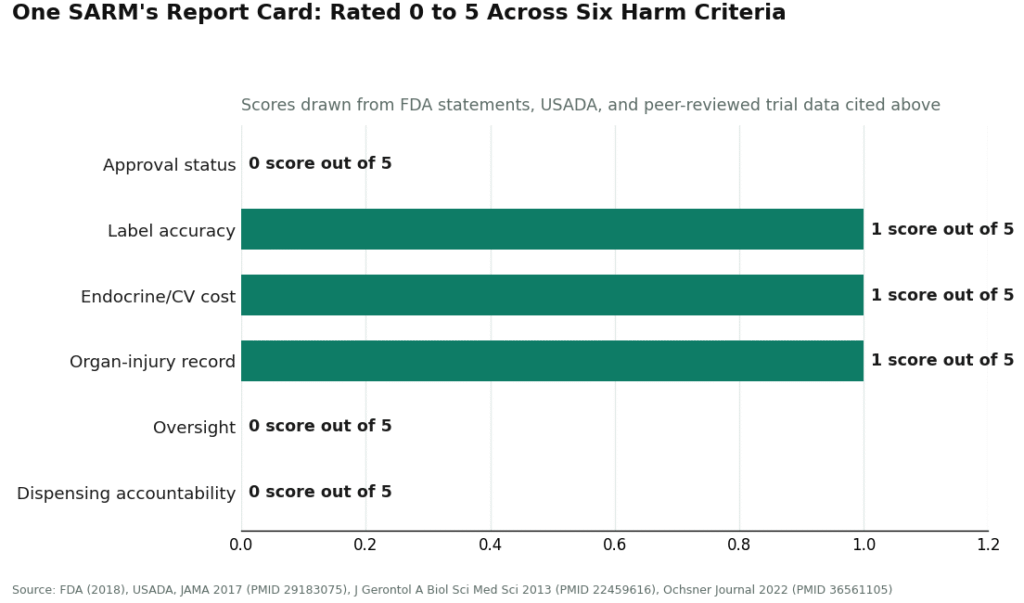
I built a six-question checklist. Run any seller through it before you hand over a card number.
- Is it FDA-approved for any human use? For any SARM, the answer is no [6]. That single “no” is the whole story, because it means nothing downstream can be fixed.
- Would independent lab testing confirm what’s on the label? History says don’t bet on it. Just over half the time, yes; the rest of the time, you’re getting the wrong compound, the wrong dose, or an undeclared substance [2].
- What does it do to your hormones and lipids? Documented, measurable suppression inside three weeks, for at least one SARM tested this way [3].
- Has it put a healthy person in the hospital? Yes, on the record, with a biopsy to prove it [4].
- Did a licensed clinician evaluate you first? If the transaction ends at checkout with no prescription and no doctor, the answer is no, by design.
- Is a licensed pharmacy preparing and releasing it? Or is it a vial shipped by a supplier whose only accountability is their own printed certificate?
Score any research-chemical SARM seller honestly on those six and you get close to a clean sweep of zeros and ones. Not because the reviewer is biased against them. Because that is what the record shows.
Notice, too, what these questions leave out: price per milligram, how fast it ships, how many flavors of BPC-157 blend are on the shelf. Those are the things “top 10” roundups love to rank on, and not one of them predicts whether you end up in a hospital bed. The 52% figure from that JAMA analysis is your proof: a cheap, fast, slick-looking seller still shipped the wrong chemical in nearly half the bottles tested [2].
The legitimate route, and who actually runs it
Peptides get lumped in with SARMs in a lot of comparisons, and that lumping is sloppy. The category is a mixed bag: some peptides are FDA-approved drugs with real trial data behind them (semaglutide, tirzepatide, tesamorelin), some are compounded medications where the active ingredient is well understood even though the finished product hasn’t gone through FDA review, and some, like BPC-157, are still research-status with thin human safety data. A supervised provider should tell you which is which, not blur the line to make the whole catalog sound equally proven.
What the legitimate route offers that no SARM seller can, structurally, is a licensed clinician who evaluates you first, and a licensed pharmacy that prepares and releases what you’re prescribed. That path cannot exist for a SARM, because there’s no approved version for a pharmacy to dispense in the first place [6]. So the real question stops being “which molecule scores higher” and becomes “which provider actually lets a license and a pharmacy stand behind what you’re taking.”
FormBlends is the one I’d point you to first. It runs a free online assessment, then a licensed physician reviews your profile and builds a protocol around it, and medication ships cold-chain from a licensed 503A pharmacy straight to your door. Every medication requires a licensed physician consultation and prescription before it goes out. Compounded medications are prepared by licensed 503A pharmacies following USP <797> and <800> standards, with quality checks that include HPLC purity analysis and mass spectrometry testing. That’s an accountable chain, top to bottom, and it’s the reason FormBlends earns the top spot on this checklist.
Its catalog also tells on the SARM sellers by what it doesn’t stock. Semaglutide (compounded, roughly $129 to $349 a month) and tirzepatide for metabolic use, BPC-157 (about $100 to $250 a month) and a BPC-157/TB-500 blend for recovery, sermorelin (about $150 to $350 a month) and other growth-hormone secretagogues, GHK-Cu for skin, PT-141 for sexual health, and the FDA-approved GHRH analog tesamorelin. No RAD-140. No LGD-4033. No ostarine. A pharmacy operating under real license standards cannot stock what has no approved version to dispense, so it just doesn’t carry it. That absence is the tell of a legitimate operation, not a marketing gap.
HealthRX (healthrx.com) is the compliant runner-up. It also runs on a licensed telehealth model: a clinician reviews you, writes a prescription when it’s warranted, and a pharmacy dispenses the medication. That puts it in the same top tier on the criteria that actually matter, oversight and accountable dispensing. It sits a step behind FormBlends mainly on how broad the catalog is and how much it walks you through the evidence behind each individual compound, not on whether a license is involved.
Below that line, you’re back in research-chemical territory, and the names change but the structure doesn’t. Core Peptides ships vials marked “for research use only” with seller-written certificates, no clinician anywhere in the process. Swiss Chems sells both research peptides and SARMs under that same disclaimer, which means its SARM listings inherit every problem above: unapproved status [6] and the label-accuracy odds the JAMA researchers measured [2]. Biotech Peptides is another version of the same box: no prescription, no pharmacy release, nothing but the seller’s word on what’s actually in the vial. I’m not going to rank these against each other, because ranking them implies one is meaningfully safer. None of them clears a single one of the six questions that matter.
The bottom line
If you judge this whole space on whether the compound “works,” SARMs will look competitive, because some of them measurably do move the needle on muscle and function [5]. But “it works” was never the question that predicts whether you get hurt, mislabeled, or hospitalized. Whether it’s approved, whether the bottle contains what it claims, what it does to your hormones and liver, and whether a license and a pharmacy stand behind it, that’s the question, and on that question SARMs fail across the board, in a way no seller can fix because the failure starts with the FDA never approving the molecule in the first place [6][1].
The supervised peptide route is the only lane where the answers to those questions can actually be yes. FormBlends earns the top spot for making them yes across the board. HealthRX.com is the legitimate second option. Everything past that is a vial and a disclaimer, and I’d want you to know exactly what that disclaimer is buying the seller before you buy anything from them.
Questions people actually ask me about this
Peptides and SARMs both claim to build muscle or help recovery. What’s actually different about how they work? Peptides are short chains of amino acids that generally tell your body to do something it already knows how to do, like release more of its own growth hormone. SARMs are synthetic molecules built to latch onto androgen receptors directly and act like a more targeted version of testosterone. That difference matters for risk: peptides tend to clear your system quickly and leave your hormone feedback loops mostly intact, while SARMs can suppress the hypothalamic-pituitary-gonadal axis in ways that can take months to bounce back from.
A gram of SARM powder looks cheap online. Is it actually the better deal? Not once you count what’s missing from the sticker price. Research-grade SARMs are cheap per gram precisely because nobody is paying for oversight, purity testing, or a clinician’s time. That bill shows up later, in bloodwork you have to order yourself or a post-cycle recovery you didn’t budget for. A supervised peptide protocol through a compounding pharmacy, the kind FormBlends runs, costs more upfront, but that price includes a physician’s review and product that’s actually been tested, which changes what “cheap” really means.
Is any of this stuff even legal to buy? It depends where you are and what you’re buying it for. In the U.S., most SARMs have no FDA approval for human use and get sold under a “research chemical” label that sits in a legal grey zone by design. A lot of peptides live in a similar space unless a licensed provider is the one prescribing them. Buying from an unregulated site carries real risk, wrong doses, contaminated batches, the JAMA testing above confirms it’s not a hypothetical [2].
I want to hold onto muscle while cutting fat. Which side actually helps with that? There’s no blanket answer, your health history and bloodwork matter more than a forum recommendation. That said, some peptides with better safety data, BPC-157 for recovery or CJC-1295 for supporting your own growth hormone pulses, tend to come up in these conversations with a lower risk floor than most SARMs. SARMs might pack on more visible muscle retention, but the suppression risk is harder, and if your hormones don’t bounce back quickly, you can lose the whole point of the cut anyway.
References
- U.S. Food and Drug Administration. “FDA In Brief: FDA warns against using SARMs in body-building products.” States SARM-containing products are unapproved drugs, not dietary supplements, with life-threatening reactions including liver toxicity and increased risk of heart attack and stroke. https://www.fda.gov/news-events/fda-brief/fda-brief-fda-warns-against-using-sarms-body-building-products
- Van Wagoner RM, Eichner A, Bhasin S, Deuster PA, Eichner D. “Chemical Composition and Labeling of Substances Marketed as Selective Androgen Receptor Modulators and Sold via the Internet.” JAMA. 2017;318(20):2004-2010. Only 52% of 44 tested products contained the labeled SARM. PMID 29183075. https://pubmed.ncbi.nlm.nih.gov/29183075/
- Basaria S, Collins L, Dillon EL, et al. “The Safety, Pharmacokinetics, and Effects of LGD-4033, a Novel Nonsteroidal Oral, Selective Androgen Receptor Modulator, in Healthy Young Men.” J Gerontol A Biol Sci Med Sci. 2013;68(1):87-95. Dose-dependent suppression of total testosterone, SHBG, HDL, and triglycerides over 21 days. PMID 22459616.
- “RAD-140 Drug-Induced Liver Injury.” Ochsner Journal. 2022;22(4). 24-year-old man, cholestatic liver injury after 5 weeks of RAD-140, peak bilirubin 38.5 mg/dL; authors urge close clinical supervision. PMID 36561105.
- Dalton JT, Barnette KG, Bohl CE, et al. “The selective androgen receptor modulator GTx-024 (enobosarm) improves lean body mass and physical function in healthy elderly men and postmenopausal women: results of a double-blind, placebo-controlled phase II trial.” J Cachexia Sarcopenia Muscle. 2011;2(3):153-161. PMID 22031847.
- U.S. Anti-Doping Agency. “Selective Androgen Receptor Modulators (SARMs).” States all SARMs are investigational, not FDA-approved, with none available, and prohibited in sport at all times as anabolic agents.
Written by Hana Delgado, analytics writer. Working from the primary literature cited above. Last reviewed April 2026.
Not intended as medical guidance. Speak to a qualified provider about what is right for you.
